
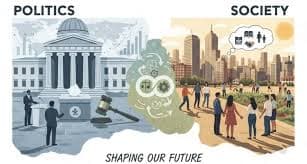
Politics is one of the most influential forces shaping a country's future. It is not merely about elections, political parties, or government leaders—it is about the decisions that affect every aspect of people's daily lives. From the quality of roads and schools to healthcare, employment, taxation, environmental protection, and national security, politics influences the direction in which a nation progresses.
In a democratic system, political power ultimately belongs to the people. Citizens elect representatives who are responsible for creating laws, framing policies, and governing the country. The success of democracy depends on transparency, accountability, and public participation. When citizens actively engage in the democratic process by voting, staying informed, and participating in civic discussions, governments become more responsive to public needs.
Political parties serve as the backbone of democratic governance. They represent different ideologies, values, and visions for the country's future. Some prioritize economic reforms and industrial growth, while others focus on social justice, welfare programs, education, healthcare, environmental sustainability, or national security. Healthy competition among political parties encourages debate, improves policymaking, and offers voters meaningful choices.
Governments face numerous challenges in balancing economic growth with social welfare. A strong economy creates jobs, attracts investment, and increases national income. However, economic development must also ensure that the benefits reach all sections of society. Policies aimed at reducing poverty, improving education, expanding healthcare, and supporting rural development contribute to inclusive growth.
Infrastructure development remains a key political priority in many countries. Investments in highways, railways, airports, digital connectivity, renewable energy, and public transportation improve economic productivity and enhance citizens' quality of life. Effective governance ensures that these projects are completed efficiently, transparently, and with minimal environmental impact.
Education and healthcare are among the most significant areas influenced by political decisions. Governments allocate budgets, establish policies, and regulate institutions to ensure access to quality services. Strong education systems prepare future generations with knowledge and skills, while accessible healthcare improves public well-being and increases life expectancy.
National security is another critical responsibility of political leadership. Governments work to protect borders, maintain internal law and order, strengthen intelligence systems, and respond to emerging threats such as cybercrime, terrorism, and organized crime. At the same time, democratic governments must safeguard civil liberties and uphold constitutional rights while ensuring security.
The rapid growth of digital technology has transformed modern politics. Social media platforms allow political leaders to communicate directly with citizens and enable people to discuss public issues instantly. While digital platforms increase political awareness and engagement, they also present challenges, including misinformation, fake news, online propaganda, and cyber manipulation. Citizens must therefore rely on credible journalism, verified information, and fact-checking before forming opinions.
Youth participation has become increasingly important in shaping modern politics. Young citizens bring innovative ideas, technological expertise, and fresh perspectives to governance. Their involvement in elections, policy discussions, entrepreneurship, environmental campaigns, and community development strengthens democratic institutions and encourages long-term reforms.
Women continue to play an expanding role in politics across the world. Increased representation of women in legislatures, local governments, and executive positions has contributed to broader perspectives in policymaking. Gender-inclusive governance often leads to stronger attention toward education, healthcare, social welfare, and community development.
Environmental sustainability has also emerged as a central political issue. Governments worldwide are developing policies to combat climate change, reduce pollution, promote renewable energy, conserve forests, and protect biodiversity. Political decisions made today will significantly influence the environmental conditions inherited by future generations.
Transparency and accountability are essential components of good governance. Independent institutions, free media, judicial oversight, anti-corruption agencies, and active civil society organizations help ensure that governments remain accountable to the public. Open governance builds public trust and strengthens democratic institutions.
International relations represent another important dimension of politics. Countries engage in diplomacy, trade agreements, defense cooperation, cultural exchanges, and multilateral organizations to promote peace, economic development, and regional stability. Effective foreign policy balances national interests with global responsibilities while fostering cooperation among nations.
Political stability is often associated with sustained economic growth and investor confidence. Stable governments are generally better positioned to implement long-term reforms, improve infrastructure, strengthen institutions, and attract domestic and foreign investment. However, political stability must always be accompanied by democratic accountability, respect for human rights, and constitutional governance.
An informed electorate is the cornerstone of any successful democracy. Citizens who understand public policies, evaluate government performance objectively, and participate responsibly in elections contribute to better governance. Education, civic awareness, and independent journalism play vital roles in developing politically informed societies.
Ultimately, politics is not confined to government buildings or election campaigns. It is present in every public policy that affects people's lives. Responsible leadership, active citizenship, transparent institutions, and constructive public debate are essential for building a prosperous, inclusive, and democratic society. As nations face complex challenges in the twenty-first century, effective political leadership and informed public participation will remain crucial in shaping a better future for generations to come.